Sandhill Cranes, Cackling Goose, other field notes, Nov. 11, 2014

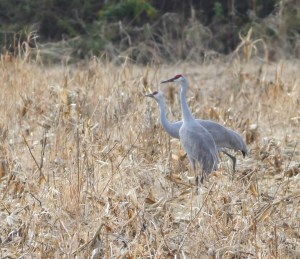
Sandhill Cranes, Franklin Twp., NJ, Nov. 11, 2014 (photo by Jonathan Klizas)

Sandhill Cranes, Franklin Twp., NJ, Nov. 11, 2014 (photo by Jonathan Klizas)

(Click on the photo for a larger image.)

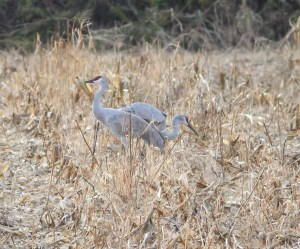
The two Sandhill Cranes of Franklin Township continue in the Randolph Road, Franklin Township corn stubble. At 3:15 this afternoon, they were opposite the building at 100 Randolph Road. Hopefully, enough sustenance is in these fields to keep the cranes in the area for an extended stay, as they have most of the past seven winters (this is the eighth).

Curiosity begets the question: where are the others?

In previous years as many as five or more have spent the autumn/winter season in Franklin Township. Maybe the current number of cranes is meaningless, but with the rapid encroachment of development in the immediate vicinity of Randolph Road, how long will the cranes find the area hospitable.

Sandhill Cranes, Franklin Twp., NJ, Nov. 11, 2014 (photo by Jonathan Klizas)

Sandhill Cranes, Franklin Twp., NJ, Nov. 11, 2014 (photo by Jonathan Klizas)


The Cackling Goose of the Lord Stirling equestrian fields at the west end of Lord Stirling Road in Bernards Township, was present as of yesterday afternoon, November 10. It was with hundreds of Canada Geese. If not found at the field, check the ponds of the nearby Somerset County Environmental Education Center (Lord Stirling Park).


10 flyover Horned Larks, a Common Loon and 38 Bufflehead were at Budd Lake this morning (David Bernstein).


From Liz Mershon:
“Holly H. & I were at Glenhurst Meadows late this afternoon. We had Am. Tree Sparrows and Winter Wrens. At the community garden parking lot, a flock of 35+ American Pipits flew from field on south side of road to north side multiple times.”

Posted in Morris County, Somerset County | Tagged , , , , , , , , | Leave a comment

38 Raptors at Chimney Rock, Martinsville, NJ, Nov. 11, 2014

Chimney Rock
Martinsville, NJ, USA
Daily Raptor Counts : 11/11/2014

Species Day’s Count Month Total Season Total
BV 0 0 0
TV 0 0 0
OS 0 0 362
BE 0 15 209
NH 2 35 153
SS 18 177 2563
CH 1 28 244
NG 0 1 1
RS 9 141 304
BW 0 0 6472
RT 6 190 254
RL 0 0 0
GE 0 6 19
AK 0 5 880
ML 2 7 265
PG 0 0 3
UI 0 2 34
Total 38 607 11763
Hours 7.5 76.8 583.2

Notes : Balmy November weather with SW winds. Good result of 38
raptors on the unfavorable wind direction.~10,000 grackles in
waves. 55 Pine Siskins, 10 Purple Finches. Many Yellow-rumped
Warblers feeding on abundant insects. Mourning Cloak Butterfly.
Lots of gnats and ladybugs.

John Kee

Daily Totals
Bird Checklist Query
2014 Summary (standard)
Species Checklist for Nov 11, 2014
Hourly Stats Report

Posted in Chimney Rock Hawkwatch | Tagged , , , , , , , , , | Leave a comment

13 Ravens, 14 Raptors at Chimney Rock, Martinsville, NJ, Nov. 10, 2014

Chimney Rock
Martinsville, NJ, USA
Daily Raptor Counts : 11/10/2014

Species Day’s Count Month Total Season Total
BV 0 0 0
TV 0 0 0
OS 0 0 362
BE 0 15 209
NH 2 33 151
SS 4 159 2545
CH 0 27 243
NG 0 1 1
RS 5 132 295
BW 0 0 6472
RT 3 184 248
RL 0 0 0
GE 0 6 19
AK 0 5 880
ML 0 5 263
PG 0 0 3
UI 0 2 34
Total 14 569 11725
Hours 8.5 69.3 575.7

Notes : Slow pick on SW wind. At 2:05 PM a group of 13 Ravens was
observed. This was confirmed by 3 counters who have been
observing resident ravens all season. ~750 grackles.

John Kee

Daily Totals
Bird Checklist Query
2014 Summary (standard)
Species Checklist for Nov 10, 2014
Hourly Stats Report

Posted in Chimney Rock Hawkwatch | Tagged , , , , , , , , , | Leave a comment

70 Raptors at Chimney Rock, Martinsville, NJ, Nov. 9, 2014

Chimney Rock
Martinsville, NJ, USA
Daily Raptor Counts : 11/9/2014

Species Day’s Count Month Total Season Total
BV 0 0 0
TV 0 0 0
OS 0 0 362
BE 0 15 209
NH 4 31 149
SS 21 155 2541
CH 5 27 243
NG 0 1 1
RS 21 127 290
BW 0 0 6472
RT 17 181 245
RL 0 0 0
GE 0 6 19
AK 0 5 880
ML 1 5 263
PG 0 0 3
UI 1 2 34
Total 70 555 11711
Hours 8.5 60.8 567.2

Notes : Sharp-shinneds, Red-shouldereds and Red-taileds moving on the
West winds. A sprinkling of Harriers, Cooper’s and a Merlin
rounded out the list. No Eagles today.

John Kee

Daily Totals
Bird Checklist Query
2014 Summary (standard)
Species Checklist for Nov 9, 2014
Hourly Stats Report

Posted in Chimney Rock Hawkwatch | Tagged , , , , , , , , | Leave a comment

The Enhancement of Land, Water, and Wildlife Habitat At Troy Meadows

Troy Meadows looking north from Troy Brook, Nov. 9, 2014 (photo by J. Klizas)

Troy Meadows looking north from Troy Brook, Nov. 9, 2014 (photo by J. Klizas)

The Enhancement of Land, Water, and Wildlife Habitat At Troy Meadows
 By:  Len Sunchild, November 1, 2014

Troy Meadows is a US National Natural Landmark located in the central Passaic basin, in northern New Jersey. It is owned by a private, nonprofit organization — Wildlife Preserves, Inc. and managed as a natural area and wildlife sanctuary.

Troy Meadows is a mix of meadows, fields, and forests containing a variety of common and endangered plant and animal communities and many biological features, ponds and vernal breeding pools. It is part of the Atlantic flyway and serves as a staging area for migratory waterfowl.  It is an exceptional resource for many species of fauna and flora and contains a dense population of avian and amphibian species, a particular haven for frogs, salamanders, and marsh birds.

Troy Meadows was once rated the “highest quality inland wetland in the State of New Jersey” by the US Department of Interior (published in its 1954 nationwide inventory of wetlands resources) but has since been degraded by encroaching suburban development, water and silt pollution, and invasive species of plants that are taking over its once native, natural habitat.

Recently, Wildlife Preserves began the first phase of an aggressive campaign to remove invasive species of plants from the meadows and woodlands at north-end of Troy Meadows in an effort to enhance the freshwater marsh, woodlands, and wildlife habitat there. The project includes installing over two miles of deer exclusion fencing around woodland habitat and replanting the meadows and woods with native plants species.

All the invasive species—from phragmites reed grass, Japanese barberry, to stilt grass—have been located and mapped and scheduled for eradication. Studies have shown that the dense stands of reed grass have raised the level of the marsh by several feet, displacing the water that was once so prevalent and important for marsh and migratory birds at Troy Meadows. And of course barberry and stilt grass fill the land and smother the seed-bearing flora that provides food, shelter, and habitat for indigenous fauna. All these invasives have created an imbalance in the ecosystem and this is the blight that many environmental organizations and individuals are attempting to heal.

The Troy Meadows project is a five to twenty-year plan that includes the establishment of a wetland mitigation bank, deed restricting the mitigation area in perpetuity, eradicating all the invasive species of plants, replacing them with native species, and restoring the meadows to its previous pristine condition.

The story begins with a fight and ends with a positive outcome.

In 2013, PSE&G upgraded its electric transmission lines from Susquehanna, Pennsylvania to Roseland, New Jersey. The project was known as the S-R electric transmission line project. It increased the electric transmission from a single 230,000 volts— 230kV line to a duel line of 230kV and 540kV. It replaced the old 95-foot lattice towers with new 195-foot monopoles and increased the conductor running between the poles from 5 wires to 18.

The PSE&G line happens to run through Wildlife Preserves’ property at the north-end of Troy Meadows. It encompasses a corridor 1-½ miles long and 150 feet wide and it includes 8 towers. Wildlife Preserves is the largest, single private landowner over which the S-R power line project traversed.

In the process of building the project, PSE&G replaced its old, dilapidated boardwalk with a new, elevated, fiberglass walkway over the marsh (dubbed the “Green Mile” by its contractors). The project also required building a construction yard and helicopter landing area at Troy Meadows, which has since been restored.

In an effort to mitigate and help alleviate the disturbance to the environmental that the S-R transmission project was expected to cause at Troy Meadows, PSE&G agreed to fund a water and wildlife enhancement project at Troy Meadows. It was first proposed and studied to restore an old trap skeet range at the end of Troy Meadow Road, but the project proved to be too expensive because there were substantial costs to remove the spent clay skeet, shotgun wads, and lead pollution before any enhancement could even begin. Wildlife Preserves and PSE&G finally settled on a plan that Wildlife Preserves would build a wetland mitigation bank and PSE&G would fund its initial start up cost.

As part of its avian mitigation, PSE&G also installed wood duck boxes in the marsh under its line, but when Wildlife Preserves objected to the location, PSE&G provided Wildlife Preserves with additional wood duck boxes that are being installed along the woodland fringes.

In October, 2014, after over a year and a half of study and reports, Wildlife Preserves was issued its NJ DEP General Permit No. 16 to eradicate invasive species of plants at Troy Meadows. Wildlife Preserves hired Allied Biological to spray the phrag, which they did using two swamp track vehicles—an Argo and a Marsh Master. The initial application encompassed the treatment of 100 acres of phragmites and took two weeks to treat.

In the springtime Wildlife Preserves intends to remove 28 acres of barberry and 131 acres of stilt grass. Eventually Wildlife will install 100 acres of deer exclusion fencing and plant 14 acres of native, woodland plants and 16 acres of wetland plants. Ultimately when the Troy Meadows Wetland Mitigation Bank is approved, Wildlife Preserves will grant a conservation restriction easement to the DEP on 560 acres of land at the north end of Troy Meadows, in Parsippany-Troy Hills between Troy Meadows Road and the interstate highways (Route 80, Route 280, and the 80/280 interchange).

See: WildlifePreserves.org for more information.

Any questions or concerns can be directed to Len@WildlifePreserves.org

Troy Meadows, NJ, Jan. 4, 2014 (photo by J. Klizas)

Troy Meadows, NJ, Jan. 4, 2014 (photo by J. Klizas)


Winter Wren, Troy Meadows, NJ, Nov. 9, 2014 (photo by J. Klizas)

Winter Wren, Troy Meadows, NJ, Nov. 9, 2014 (photo by J. Klizas)

Birds of Troy Meadows

Troy Meadows is a very famous place for birds, birdwatchers, and wildlife photographers.

There are a number of publications regarding the bird species of Troy Meadows, among them are two scholarly books on bird species, both sponsored by the American Museum of Natural History. The most notable and available is Birds of the New York Area, by John Bull, Harper and Row, 1964— See:  American Bittern, Lest Bittern, Wood Duck, Virginia Rail, Sora, Red-Headed Woodpecker, Short-Billed Marsh Wren; page 107, pg. 108, pg. 133, pg. 159, pg. 174, pg. 286, and pg. 330.

In Birds of the New York Area, John Bull reports that in 1947 the Urner Bird Club reported 13 nesting pairs of American Bittern, 10 nesting pair of Least Bittern, 25 breeding pair of Virginia Rail, 14 breeding pair of Sora, and 8 pair of Short-Billed Marsh Wren at Troy Meadows.

In mid-fall, 1960 over 1,000 Wood Ducks were observed in an all-day canoe trip through Troy Meadows, “estimated 700 in one flock and 300 in another.” Regarding the 1960 Wood Duck report, John Bull comments, “Penetration by boat into the heart of this swamp is the best method to cover such a vast area. By comparison, a count from the boardwalk would produce only a small fraction of this number.”

The 2013 Audubon Christmas bird count reported 43 Red-headed Woodpeckers, carefully counted at Troy Meadows; possibly the one of the highest counts on record in any one location in New Jersey; “it obliterates its previous high count of 20 Red-headed Woodpeckers at Troy Meadows set in 2001.”

From 2012 to 2014, Wildlife Preserves commissioned BR Environmental Services to survey wildlife and wildlife habitat at Troy Meadows. Among all the threatened and endangered species reported in the winter/spring of 2014, BR Environmental located several nesting pair of Red-headed Woodpeckers in old dead trees along the Whippany River and within the woodland islands at Troy Meadows.

Other threatened and endangered avian species recently sighted and reported at Troy Meadows are— Savannah Sparrow, American Bittern, Least Bittern, and Black Crown Night Heron— all sighted in Troy Meadows, Par-Troy (2012), a Barred Owl nest cavity in Troy Meadows, Par-Troy (2012), Red-Shouldered Hawk nest in Troy Meadows, E. Hanover (2012), Red-Headed Woodpecker nest cavities in Troy Meadows, E. Hanover and Par-Troy (2014), American Bald Eagle nests in Troy Meadows, Par-Troy, and Great Blue Heron rookery in Troy Meadows, East Hanover.

Considering all the rare and endangered species of fauna and flora at Troy Meadows, unfortunately the only avian species the public seems to care about are the American Bald Eagles nesting at Troy Meadows. The only birds the newspapers care to write about are the eagles at Troy Meadows and the eagles got top billing during the planning and construction of the PSE&G Susquehanna-Roseland electric transmission line project, while other rare species were ignored.

Besides the three eagle nests at Troy Meadows (some active and some abandoned) there is also a pretty substantial Great Blue Heron rookery in the woodlands along the Ash Swamp in Troy Meadows.

As Wildlife Preserves’ current campaign to remove invasive species of plants from the meadows and woodlands at north-end of Troy Meadows continues and its wetland mitigation bank project progresses, the wildlife habitat at Troy Meadows will improve and resident and migratory avian populations of marsh birds and waterfowl should increase.

Birders are encouraged to submit photos and reports to WildlifePreserves.org and threatened and endangered species sightings to NJ DEP.

By:    Len Sunchild, November 1, 2014

Len@WildlifePreserves.org

[Editor’s note: On hearing of the Phragmites removal project at Troy Meadows, mocosocoBirds contacted Len Fariello, Land Manager for Wildlife Preserves. Len graciously penned the previous essay. We thank Len for his time and effort in helping to preserve and maintain Troy Meadows.]

Red-headed Woodpecker, Troy Meadows, NJ, Jan. 4, 2014 (photo by J. Klizas)
Red-headed Woodpecker, Troy Meadows, NJ, Jan. 4, 2014 (photo by J. Klizas)
Posted in Morris County | Tagged , , , , , , , | 1 Comment

44 Raptors at Wildcat Ridge, Hibernia, NJ, Nov. 8, 2014

Wildcat Ridge
Hibernia, New Jersey, USA

Daily Raptor Counts: Nov 08, 2014
Species Day’s Count Month Total Season Total
Black Vulture 0 0 0
Turkey Vulture 0 0 0
Osprey 0 0 76
Bald Eagle 5 5 71
Northern Harrier 1 1 17
Sharp-shinned Hawk 14 17 405
Cooper’s Hawk 3 3 120
Northern Goshawk 0 0 1
Red-shouldered Hawk 2 2 8
Broad-winged Hawk 0 0 6465
Red-tailed Hawk 19 22 45
Golden Eagle 0 0 0
American Kestrel 0 0 77
Merlin 0 0 7
Peregrine Falcon 0 0 5
Unknown Raptor 0 0 17
Total: 44 50 7314


Observation start time: 09:00:00
Observation end time: 15:00:00
Total observation time: 6 hours
Official Counter Fred Vanderburgh
Observers: Mike L., Tom G.


Visitors:
Visitors = 37

Weather:
Temperature 41-51F, 20% cloud cover, visibility 20 miles, wind 3-5 with occasional gust to 10 mph from the NW shifting to the SW.

Raptor Observations:
Migrants started appearing about 10:30 with the NW wind. The flight stalled when the wind shifted to the SW late in the afternoon. A good species mix that included 2x Adult Bald Eagles together @ 11:40, 2x WBII Bald Eagles @ 12:42 and a solitary Immature BE @ 12:50.

Non-raptor Observations:
Five Ravens migrated out together.


Report submitted by Fred Vanderburgh
Wildcat Ridge information may be found at: http://www.njfishandwildlife.com/wldcthwk.htm

Posted in Wildcat Ridge | Tagged , , , , , , , , | Leave a comment

68 Raptors at Chimney Rock, Martinsville, NJ, Nov. 8, 2014

Chimney Rock
Martinsville, NJ, USA
Daily Raptor Counts : 11/8/2014

Species Day’s Count Month Total Season Total
BV 0 0 0
TV 0 0 0
OS 0 0 362
BE 1 15 209
NH 3 27 145
SS 28 134 2520
CH 0 22 238
NG 0 1 1
RS 15 106 269
BW 0 0 6472
RT 20 164 228
RL 0 0 0
GE 0 6 19
AK 0 5 880
ML 1 4 262
PG 0 0 3
UI 0 1 33
Total 68 485 11641
Hours 8.8 52.3 558.7

Notes : Decent flight considering the SW winds today. Many thousands
of grackles migrating through, with one observer putting the
number between eight and ten thousand.

John Kee

Daily Totals
Bird Checklist Query
2014 Summary (standard)
Species Checklist for Nov 8, 2014
Hourly Stats Report

Posted in Chimney Rock Hawkwatch | Tagged , , , , , , , , , | Leave a comment

Saturday Bird Notes, Nov. 8, 2014

Mt. Hope, Rockaway Township

Mt. Hope Lake, NJ, Nov. 8, 2014 (iPhone pano by Jonathan Klizas)

Mt. Hope Lake, NJ, Nov. 8, 2014 (iPhone pano by Jonathan Klizas)

The above photo is a panoramic view from the southwest end of Mt. Hope Lake in Rockaway Township (labeled Mill Pond on Google maps). Mt. Hope Pond, a different, smaller body of water, is further up Mt. Hope Road from Mt. Hope Lake. Be aware of this potential confusion.

In the upper left of the photo, one can barely see the buildings of the historic Leonard Mine. Historic because the Mt. Hope mine may be the oldest in the country. The mine shaft goes beneath the earth 2,700 feet. This is thought to be the deepest shaft east of the Mississippi River. Mining operations ceased in 1981. The property is owned by Tilcon. In front of the buildings is a tree with a Bald Eagle nest. The eagles continue to hang out at the lake although they apparently abandoned nesting activity this year. The grounds surrounding the lake are leased by the Rockaway Township Sportsmen Club. There is much signage in the area advertising that. Please respect their boundaries if you visit the lake. Hiking is strictly forbidden.

Mt. Hope is probably the most productive waterfowl lake in Morris County. Currently there are Ring-necked Ducks, Northern Shovelers, Gadwall, American Wigeon, Wood Ducks, Mute Swans, American Coot, etc. Historically, nearly every regular occuring waterfowl species has appeared here as well as Eurasian Wigeon, Forster’s Tern and Bonaparte’s Gull. There is currently a semi-resident uncountable Trumpeter Swan thought to be an offspring of the Bernardsville captive pair. Yesterday, 4 Canvasbacks were observed at the lake. Today, the Canvasbacks were gone but replaced by 3 Common Goldeneye hens found by David Bernstein. It is a busy lake with changing waterfowl dynamics, especially at this time of year.

The predominant duck of Mt. Hope is the Ruddy Duck. The above photo makes the lake look like a placid, innocuous body of water, but lurking on that surface are 1,020 Ruddy Ducks. I know because I counted them today. First by singles, then by groups of 5 and 10. The conditions were perfect for visibility with bright sun and calm waters. This is the all-time high count of Ruddy Ducks in Morris County as far as is known. 900, the previous high, were tallied in 2013.


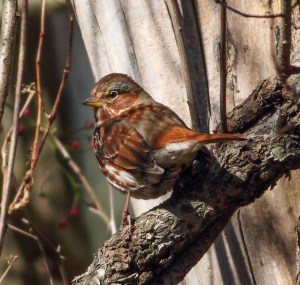
Fox Sparrow, Jonathan's Woods, NJ, Nov. 8, 2014 (photo by Jonathan Klizas)

Fox Sparrow, Jonathan’s Woods, NJ, Nov. 8, 2014 (photo by Jonathan Klizas)

5 Fox Sparrows were in a group at Jonathan’s Woods this morning.

Fox Sparrow, Jonathan's Woods, NJ, Nov. 8, 2014 (photo by Jonathan Klizas)

Fox Sparrow, Jonathan’s Woods, NJ, Nov. 8, 2014 (photo by Jonathan Klizas)


From Terry Carruthers:
“A Cackling Goose was visible at Lord Stirling equestrian fields today. A Fox Sparrow and three Purple Finches were visiting my feeders on Whitebridge Rd.” [ The Cackling Goose is fairly regular at this location this week with many reports. The equestrian fields are at the western end of Lord Stirling Road. If the goose is not found on the fields, check the ponds at the Somerset County Environmental Education Center, aka, Lord Stirling ParkEditor].


In the continuing series of Snow Bunting photos from Budd Lake, below is a photo from Nov.7 by Tom Halliwell. Clicking on the photo will bring you to Tom’s Flickr photostream where an abundance of wonderful butterfly, odonate, plant and other nature photos reside. Incidentally, the Snow Buntings are still present as of today.

Snow Bunting, Budd Lake, Morris County 11-7-14


Below is a Hermit Thrush bathed in the early morning sun at Timberbrook Lake.

Hermit Thrush, Timberbrook Lake, Rockaway Twp., NJ, Nov. 8, 2014 (photo by Jonathan Klizas)

Hermit Thrush, Timberbrook Lake, Rockaway Twp., NJ, Nov. 8, 2014 (photo by Jonathan Klizas)

Posted in Morris County, Somerset County | Tagged , , , , , , , | 2 Comments

48 Raptors at Chimney Rock, Martinsville, NJ, Nov. 7, 2014

Chimney Rock
Martinsville, NJ, USA
Daily Raptor Counts : 11/7/2014

Species Day’s Count Month Total Season Total
BV 0 0 0
TV 0 0 0
OS 0 0 362
BE 4 14 208
NH 0 24 142
SS 7 106 2492
CH 6 22 238
NG 0 1 1
RS 23 91 254
BW 0 0 6472
RT 8 144 208
RL 0 0 0
GE 0 6 19
AK 0 5 880
ML 0 3 261
PG 0 0 3
UI 0 1 33
Total 48 417 11573
Hours 8.0 43.6 549.9

Notes : Brisk NW winds could not dislodge our fearless Counters today.
However, it did get 23 Red-shouldered Hawks moving through.
Today’s 4 Bald Eagles tallies the second best season to date for
this species.

John Kee

Daily Totals
Bird Checklist Query
2014 Summary (standard)
Species Checklist for Nov 7, 2014
Hourly Stats Report

Posted in Chimney Rock Hawkwatch | Tagged , , , , , , , , , | Leave a comment

Friday Bird Notes, Nov. 7, 2014

Canvasbacks

From 2 to 4 Canvasbacks are reported from Mt. Hope Lake today (Dave Bernstein, Chris Thomas). This is not an easy species to find in Morris County during some years. Only three other reports are recorded for 2014, all from March and all one-day wonders (click on the date to see the report): March 10 at Loantaka Brook Reservation (see the superb photo by Jim Gilbert); March 23 at Lincoln Park; March 27 at Lake Musconetcong.


Snow Buntings

Three Snow Buntings remain faithful to the municipal beach area at the southern end of Budd Lake (Chris Thomas, Alan Boyd, Tom Halliwell). This is another difficult species to locate in Morris County during most years. Twitch it while you can.

Snow Bunting

(Snow Bunting at Budd Lake, NJ, Oct. 7, 2014, photo by Chris Thomas)


Sandhill Cranes

Two Sandhill Cranes returned to Randolph Road, Franklin Township according to a JerseyBirds post from yesterday, November 7. The two cranes were eBirded by Steven Albert today.

This marks the eighth known consecutive year Sandhill Cranes are frequenting this section of Franklin Township. Also, as far as is known, this is the earliest they are recorded on their return in the autumn. Late November was previously thought to be their usual return time frame. It will be interesting to see how increasing development in the immediate area will affect the crane’s fidelity to these wintering grounds.


@mocosocoBirds at Twitter is another communications stream. Instant field reports and links of interest are tweeted throughout the day. The latest tweets appear on the sidebar of the mocosocoBirds.com web page. One can follow mocosocoBirds at Twitter or link to @mocosocoBirds.


View eBird checklists and other data at the following links.
Click on the Checklists tab of the BirdTrax applet to display the most recent checklists. Click on this icon, checklist-nobox ,to view the contents of the checklist:

Posted in Morris County, Somerset County | Tagged , , , , , , , | Leave a comment